Here is the podcast of a working paper I recently delivered (2-12-14) on grandfatherhood, masculine being and ageing in Dominica, at Oxford university.
I presented at a multidisciplinary 'Generational Change in Reproductive Cultures' seminar funded by the Institute of Social and Cultural Anthropology and the Galton Institute @ Oxford, and convened byDr Kaveri Qureshi (Research Fellow, ISCA, University of Oxford) and Dr Sian Pooley (Lecturer, Faculty of History, University of Cambridge)
....thank you to both of them for the invitation and I commend them on a fascinatingly diverse and well organised series.
Tuesday, 11 February 2014


Sunday, 2 February 2014
'The Esu of Forgiveness or Black fatherhood takes the long way round' [repost of an excellent essay-commentary By Roger Bonair-Agard]
[Originally posted FRIDAY, JANUARY 17, 2014]

The Esu of Forgiveness or Black Fatherhood takes the long way round
My father married at 19, emmigrated to Canada with his new wife. By 22, he had three children – his marriage floundering. He met my mother somewhere around that time, at McGill University in Montreal. They were both from Trinidad – opposite ends of the island. My mother remembers him as a serious, organized student. He helped her study for an important English final. During the summers they would hang out together in New York, where my mother worked as a nanny for a wealthy family to put herself through school. On my father’s 25th birthday, my mother was 7 months pregnant with his 4th child – me. He was in Montreal. My mother having graduated was in New York. There are conflicting versions of the communication that took place between them, but he wasn’t there – for her pregnancy, for my birth, for any of the 2 years my mother had to leave me in the care of a foster family and return home to Trinidad to look for a job, before she returned to get me and take me home.
My father came home to Trinidad once or twice a year. My mother would call him to remind him of birthdays and to send something for Christmas. I grew up without him. I am – if you read every report about black youth – a statistic. According to the ‘evidence’, anecdotal and otherwise, black fathers routinely abandon their children, and they’re left to the ravages of a world that preys on children. Listen closely to the timbre of some of this evidence and you’ll hear the strains of ‘this is really the reason that black children flounder – their absentee fathers, their single mothers, their lack of sustained family units and relationships and their failure has nothing to do with any larger forces we may want to ascribe to it.’ Listen closer and you’ll hear some other things about blackness too, but – one thing at a time.
+++
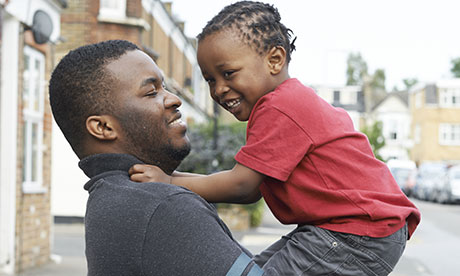
I am today, a father – a black father. To be sure, the jury is not yet in on the success or failure of my attempts at fatherhood. At the writing of this, my daughter – my first child – is only 8 months old. There are several years of testing to go before I can say I’ve been a great, or even adequate father. Still, I moved to a city that I didn’t want to live in so I could be there for my daughter. This is not something that requires an ovation. It is part of what I see as my job. I consider myself lucky to have become a first time parent at the advanced age of 45. I have significantly more clarity than your average 25 year old about what kind of parent I want to be. I’ve significantly more sense of who I am and what patience means and requires – not because I’m wonderful, but because I’ve survived. Moreover, I look around me at my friends – other black fathers, and what I see is the most dedicated cadre of fathers you can think of – men who are not only shouldering their share of the financial burden, but working hard to be there for their sons and daughters regardless of the state of the relationship with the mothers of those children. Indeed, not one black man with whom I have an intimate relationship can be said to have abandoned his children. Wherefore then this idea that black men are more likely to not be there for their kids? How then did this narrative get born?
+++
I’m a freelance teacher of creative writing. Among the places I do this work is in juvenile jail. You probably know where I’m going with this thread. Many of my students have not had the privilege of involved fathers. They are all Black and Latino. They almost all come from Chicago’s South and West sides, which in the context of America’s continued segregation, means neighborhoods of low socio economic status and entirely black and brown. Further, a significant number of their fathers have also been in prison or continue to be in prison. The stories are as common among that population, as they are heart-breaking. Their fathers give them what advice they can – father them however they know, until they are taken away again. Uncles and grandmothers and mothers pick up the slack. Indeed uncles and grandmothers and older folk in the neighborhood are involved whether or not the fathers are there. The village attempts to raise because it has no choice – because their schools are terrible. There are no resources. Jobs are scarce and they fall back on the extended family – the family that existed before industrialization and modern business slicked us with the con game of the nuclear family, cleaved from the rest of its support, to fend for itself in a post-industrial landscape.
+++
I’m running away with a rant now. My daughter laughs when I go into her room to get her in the morning. She can’t believe I’ve come back. She continues to shriek as I read to her while she holds the bars of her crib and bounces up and down maniacally. She fusses through the changing of her clothes and we head out to the bus – or the subway. Everyone smiles at me on the street. White women who pretend I’m ether when I’m alone, talk to me at the streetlights waiting to cross. Occasionally, I end up with a free ride on the bus – if I’m scrambling for my bus card or it turns out that I miscalculated and my card hasn’t enough of a balance on it. I’m praised for the simplest act of caretaking – the body of my child strapped to mine as I go about my daily business. Black women are often ecstatic or confused. I am a menace when alone, something to be sized up. With my child I’m somewhere between magically visible and an alien from a foreign land. So much of what we believe about ourselves is a confusing mélange of lived experience, a con job about what should be, and statistics, damned lying statistics.
+++
Here’s what I’ve come to notice: in general white men are far more awkward with Nina (especially in her first 3 months) than black men have been. They are scared to hold her, or think she’s too little – scared they might break the infant. They’ve had no experience with children in their family they say, or, they’ve never been asked to hold a child even if there’ve been children there. Mostly, these white men are young middle-American and middle-class. They fit comfortably into narratives of who they are as ‘men’ in their society. Not much comes up to make them question their manhood in the general scheme of the dominant white American narrative, even though they’re progressive, liberal white men in most cases. I guarantee that none of these men has ever heard it questioned whether he will or will not be present when he has a child.
Almost to a man the black men in my life and black children for that matter, pick Nina up as if it’s a matter-of-fact. They feed her – from their fingers even as did my best friend’s 13 year old son. They signify all the various ‘tones’ of blackness we’ve come to identify. They’re intellectuals. They’re titans of commerce. They’re violent cops. They’re thugs and reformed thugs. They’re hat backwards freestyling on the train youths and their ability to be tender and show love is not new to me, but I’m an old man now and my daughter is my everything and black men close to me hold her like she is everything to them too. They’re villagers, raising our children. Why is this important? Because this is an image of black manhood that we are nowhere in public representations of black men allowed to see. The narrative that dominates is that black men are menacing and frightening and it is necessary to stand one’s ground against them (even if they’re running away) and this narrative goes even further to not just criminalize but animalize black men with the idea that we’re to expect that they/we, would abandon our young.
I have several white friends whose fathers weren’t there. I know of white youth whose fathers didn’t manage to stay. None of them seem to be treated as part of a statistic. None of them seems to walk around with the ‘knowledge’ that this is part of some cultural statistical yoke they must wear. Indeed, in most of their interactions, others are surprised to learn this about them. I have several white friends whose fathers were there, whose fathers are, indeed, still married to their mothers. Some of them have parents who ‘waited until the children were gone’ to leave. Some of those people wish to all the gods that their parents had divorced. Some of them have parents who share an incredible love. Some of them are working through years of therapy to parse their parents’ relationships. No-one is surprised to learn about my father’s absence – to know this as a thing about me, because I’m black. This includes black people and Latino people and white people. We’ve bought the idea inter-generationally that we don’t take care of our children – that we are somehow incapable of nurture. Since we’re on statistics, those will also let you know that black men are at least (depending on where you are in the country) three times more likely to be convicted for a crime of the exact same circumstance as white men are. The socio-economic undertones of conviction for crack-cocaine as opposed to powder, and the generally racist undertones of the war on drugs have carted black and brown men off to prisons in record numbers in the last 30 years. Indeed, America has found a way to cart black men off to jail at numbers far exceeding that of their white counterparts from the moment Reconstruction ended. These arguments are not separate from the narrative of absentee fatherhood in black communities. The critique about a crisis in black fatherhood cannot be had without examining where black fathers go and why, when indeed they are absent. It cannot be had without also talking about why black boys and girls are adultified in the media and the criminal justice system, and anywhere they are encountered, with often deadly consequences. It cannot be had as a discussion without also having the discussion that the ability to freely go to the polls has only existed for black people in this last generation; in mylifetime.
My friend, Camille tells of how her mother hated to take her and her sisters shopping. For her, a young woman who grew up in the 80s and 90s, the idea of shopping was a joyous occasion. She could never understand why her mother didn’t share in their joy. As an adult, she asked her mother who revealed that as a girl in Houston, when her own mother took her shopping for shoes, she’d have to have her foot outlined and presented to the clerk, because black people were not allowed to try shoes on – shoes that presumably might also have to end up on white feet. Shopping, even in the 50s and 60s meant subjecting oneself to constant indignity. Of course, the shopping example is only microcosmic about what all black life has been like in America up to very recently. The decimation of schools in black neighborhoods, the prison industrial complex, Trayvon Martin and the 188thday since George Zimmerman’s acquittal, all conspire to suggest, that to speak of black fatherhood, in the context of that white American trope of nuclear family head-of-household figure, without also examining the myriad ways in which it might be made not possible or might not be the most advantageous model even, is to ask all the wrong questions and to cultivate willful ignorance. It is also to ignore that across all lines national divorce rates are around 50% and climbing, that alternative modes of family are steadily on the rise among all people, that even as we speak America is deconstructing what family means. Some of those very white friends who grew up in two-parent households aren’t sure that’s what was best ultimately. But the narrative about black men and their children morphs into a narrative about nuclear family being something we should aspire to, and must ignore all the other truths in our lives in order to maintain a nuclear household or be counted (or looked upon) as part of that statistic and conversation about ‘the breakdown of the black family.’ In this narrative, marriage is sacrosanct and without recognizing it we engage in equating non-wed parenthood with abandonment of the offspring, even when those fathers remain involved on a daily basis. We beat that idea about the head, because we desperately want it to be the reason for everything that ails ‘the black community.’ We’d rather not look to some more deeply seated, fundamental reasons for general social inequity.
+++
The Yoruba of West Africa, whose descendants peopled much of the Caribbean, and Americas through slavery, count among their orishas – their manifestations of the Godhead, Esu. He is the messenger between the human and divine worlds, Undergod of duality, crossroads and beginnings, and also a phallic and fertility Undergod, transporter of souls to the underworld. He is considered a trickster god. Think Coyote of some Native American traditions. Esu is the embodiment of that very Christian of biblical ideas that we can’t possibly fathom how God works, or know what he has in store for us. For the African in diaspora, Esu is a grounding idea (whether he participates in the Yoruba spiritual system or not). How else to explain the Middle Passage, what God’s intention is, but by the idea that He manifests as a trickster with the ability to show multiple faces of the self to others and to ourselves. I often think of Esu when I think of the myth of the absent black father, the black father gone, abandoning his charge. Among the many stories told of the playful Esu, who manifests as Elegba often in the syncretization of Yoruba and Christianity in the Caribbean and South America, is that he once walked between two rows of workers on opposite sides of a path. Half his body is painted blue, the other half red. One row of people says “Did you see that blue man?” The other row says “No, he was red!” And so they argue until Esu passes back going the other way, such that the first row says in effect “My bad, he was red” while the other argues ”No, no. you were right. He’s blue.” The essence of Esu is to remind us that not everything is as it appears, and that we must know all sides of a thing before we can locate what it really means. My therapist, a man of endless analogies, says “Do you remember the movie Close Encounters of the Third Kind? Do you remember how many people had the vision of the mountain and drew it, but got to it and couldn’t make contact? Richard Dreyfuss character made a 3-D model out of mashed potatoes or something, so when he got there, he knew he had to walk around it and go to the other side.” We were talking about cognitive behavioral understanding or some such. I was trying to understand my own actions, how I might live more honestly in them. Fatherhood, is like that – but then so is blackness, and its intersection with maleness, and its intersection with white western post industrialized life. We heed the lesson of Esu and forgive what we thought we saw the first time round. All around me are black men so full of love and tenderness for their children that I’m often on the edge of weeping for joy when I see us on the street, give dap to us when we get together. We can let statistics that want to tell one story ‘prove’ one thing to us, but we must watch what is actually happening and seek out stories on the ground; walk to the other side of the mountain to find out the real truth.

Thursday, 16 January 2014
Marcio's Story, Promundo and some Antillean Resonances
A short film about Marcio a favella dweller in Rio de Janeiro by the Brazillian international NGO Promundo, who work with men and boys on issues of gender based violence and paternal care.
Whilst something of an idyllic praise song of Promundo's work and one man's journey towards fatherhood - this father-wound to fatherhood tale certainly repeats itself in Dominican men's narratives of fatherhood.
Determined like Marco and others in his community not to do to their children as their fathers did unto them, many men in Dominica are keen to share their stories of fathering - for which they receive little public recognition - with me, an ethnographer, and learn more about becoming a good father in the small number of father's discussion sessions CariMAN Dominica have held in conjunction with various secondary schools and Dominica Planned Parenthood island-wide.
This very word - determination - to become the image of the fathers they often didn't have, renders a large portion of the contemporary generation of men in Dominica as receptive as Marco and his peers in their engagement in such discussions. However in Dominica, distrust and suspicion of others in your community who might maliciously 'speak your business' to others in defamatory ways and use any personal disclosures against you, renders many men weary of engaging in such discussions. However, when the setting is right and the atmosphere a comfortable one, discussion can be fruitful and participants overcome such doubt.

PROMUNDO's website:
http://www.promundo.org.br/en/about-us/introduction/
Whilst something of an idyllic praise song of Promundo's work and one man's journey towards fatherhood - this father-wound to fatherhood tale certainly repeats itself in Dominican men's narratives of fatherhood.
Determined like Marco and others in his community not to do to their children as their fathers did unto them, many men in Dominica are keen to share their stories of fathering - for which they receive little public recognition - with me, an ethnographer, and learn more about becoming a good father in the small number of father's discussion sessions CariMAN Dominica have held in conjunction with various secondary schools and Dominica Planned Parenthood island-wide.
This very word - determination - to become the image of the fathers they often didn't have, renders a large portion of the contemporary generation of men in Dominica as receptive as Marco and his peers in their engagement in such discussions. However in Dominica, distrust and suspicion of others in your community who might maliciously 'speak your business' to others in defamatory ways and use any personal disclosures against you, renders many men weary of engaging in such discussions. However, when the setting is right and the atmosphere a comfortable one, discussion can be fruitful and participants overcome such doubt.

PROMUNDO's website:
http://www.promundo.org.br/en/about-us/introduction/
Tuesday, 7 January 2014
'Men have children too'
A fascinating piece by Jamaican columnist, social commentator and CariMAN member on the gender laden language that frames reproduction in Jamaica.
I observe a similar use of the words 'get' and 'have' which are embedded in gendered inequities of child care in Dominica too.
Valorized idioms of male movement describe the pursuit of women ('go behind', 'make a break') and male sexual conquest ('pass around') , but then once a woman falls pregnant and she 'gives' a man a child (assigns paternity) she is sometimes accused of giving him a 'jacket' (child that is not his) or cynically falling pregnant intentionally in order to to 'hold' or 'chébé' him.
However in Dominica the term 'make' - I.e. 'to make chil'ren' - is a term applied to both men and women. It can refer to women individually - to mean bearing and birthing a child - eg, 'when I first make my chil'ren'. Or it can be a cooperative act of reproduction involving men, who 'make' children too. Although much less common, a man could similarly say 'when I first make my chil'ren', or 'I make my first chil' with'. Although, more gender neutral in terms of who uses it, the frequency with which the term 'make' is used tends to be much higher amongst women. This too is evident of the kind of unequal gendered norms Ellis highlights. Thus, in Dominica, men 'get', women 'give' and they both - though unequally - 'make' children.
Ellis provides excellent sociolinguistic food for thought in this short piece from the Jamaican Star:
--------------------------------------------

Men have children too
By OWEN ELLIS, Contributor

By OWEN ELLIS, Contributor
MOST JAMAICAN MEN make a point of distinguishing between the words 'have' and 'get' when referring to their children, and it is not a good practice. Even though it's obvious that it is their female counterparts who have the burden of the nine-month excess weight and the agony of labour, my male friends from other parts of the world seem to have absolutely no problem saying "we're having a baby!" or "I have two kids".
Jamaican men however, refuse to use the word 'have' to indicate their involvement in the process. "Is seven pickney me get!" says the big man, as he beats his chest and downs another glass of liquor. Smiles of admiration and grunts of praise fill the bar. Another guy, sipping from a can of fruit juice, says "I have four" and immediately becomes the victim of a verbal mobbing from all the men gathered. Even the female bartender gets involved. "Man stop the damn chupidness! Yu a woman? Is woman have pickney!"
Most Jamaican men appear to agree that it is important to make a very clear distinction: "we get youth, we nuh have dem!"
Men have no problem saying "I have a car" or "I have ambition" but children, no we get them. I think that is a load of male bovine crap! When we say men "get" children, we seem to be suggesting that the men have nothing to do with the process.
"I siddung here innocently minding mi own business when all of a sudden I just get a youth!" It may seem like a petty issue but it is not. The idea that women "have" and men "get" children helps to perpetuate the harmful notion that parenting responsibility is the sole prerogative of women, and men are just hapless victims who "get ketch". This is really not fair. It is especially unfair in a context where men put so much effort in trying to get women into bed, and put so much value on number of children. You work so hard to impregnate a woman then tell me that you 'got' a child? How? A raffle draw and your name call?
Or maybe it was a drive-by. Some wicked women pass and let loose a barrage of pickney and you just salt and 'get' two.
One adherent to the nonsense tried to rationalise it by explaining that the word 'have' means that you carry the child in your womb. Which dictionary tells you that? So when that same man turns to me and says "I have a brand new bike" does that mean that he gave birth to the bike? Nonsense!
We need to deconstruct some of these terminologies which only help to reinforce gender inequality. Every child that is born came into the world because a man and a woman did something together. OK, I know these are modern times and all kinds of technologically advanced methods are there so women can get pregnant all by themselves if they so desire.
But in a case where two people had sexual intercourse and a child is conceived, both are equally responsible. So please stop the rubbish. Women have children, and men have children too.
Tuesday, 5 November 2013
Pé, Ti Garcan é Kaboué: Jounnen Kweyol 2013
Independence season is drawing to a close here in Dominica. Yesterday, Sunday 3rd of November marked 35 years of (formal) independence for the Nature Isle.
The previous weekend Friday was Jounen Kweyol (creole day), a day of creole food, dress and Kweyol/Patwa language being spoke in workplaces (offices, shops, restaurants) island wide. The festivities also included a Creole dress parade.
One thing that stood out during the parade was the presence of a number of fathers walking with their sons pushing traditional style kaboués (karts) and trucks. These karts and trucks are constructed from wood and reused materials (e.g. corned beef tins for front bonnets) and painted in various colours.The making of them and walking with them is a traditional past time that now endures as a part of the Independence/creole season celebrations.
Dominicans are deeply and reflexively aware of their Culture - as an array of heritable performative traditions - being more pronounced than elsewhere in the Antilles, and they consciously work hard during the Independence season to keep its spirit strong.
These fathers have been actively engaged by the teachers of one of Roseau's primary schools (Convent Preparatory School I believe) to lend their knowledge of the practice of making these trucks and karts - notably the complex string/wire steering system - with their sons. Activities of a technical nature - such as building, making, fixing - are popular modes of father-son teaching and guidance among fathers who spend time with their sons.
I would argue that this is another notable example of the increasingly visible public profile of fatherhood in the Antilles and the availability of fatherhood as a constituting aspect of mature masculine being for some men.


Thursday, 15 August 2013
Too young to be a dad?
This post features a newspaper article focusing on the experiences of young fathers predominantly of ethnic minorities living in the UK.
Whilst only a few of the fathers featured are of Caribbean
descent, their experiences - of a gendered legal system
that marginalizes their paternal role(s) and rights; of negotiating
brittle relations with mothers whom they are not together with; and the men's
embrace of fatherhood as a central aspect of their being against a tide of
negative ideas - intimately resonates with the realities I observe in
the Antilles.
---------------------
Too young to be a dad?
Teenage fathers who want to be involved in their children's lives often find the odds stacked against them. Yvonne Roberts talks to five proud young men who battled to take on the role
The Observer, Sunday
11 August 2013

‘That’s my son’: Cory Ellison, 16, with Riley-Romero. Cory
has his son’s name and birthday tattooed on his arm. Photograph: Suki Dhanda
for the Observer
"Mark" and "Lucy" had been together for
three years, on and off, at school when, aged 16, Lucy became pregnant. Soon
after, the relationship ended. "I told her I'd broken up with her but I
hadn't broken up with our baby," says Mark, now 20. "Right from the
beginning, I wanted to be a proper dad and do what you're supposed to do."
For two years, Mark has had Katie two days a week, helped by
his parents and sister. During that time he has also been fighting through the
courts for full custody of his daughter, who is in the care of her maternal
grandmother. Several months after Katie's birth, social services had become
concerned about Lucy's drinking. Now, she sees her daughter once a week.
In Mark's case, to show the strength of his intent to the
judge and social workers, he abandoned his ambition to become an engineer,
found a full-time job in retail, took courses in parenting and asked his
employer to give him a character reference for the courts. "He said I had
great potential. I've already been promoted. I'm not bigging myself up, but
that's not bad for a 20-year-old," says Mark.
"I've asked for an independent social worker because
Katie's social worker treats me as if I'm invisible," he adds. "The
assumption is that because I'm young I can't be responsible. At one point they
tried to say I was working on the days I have Katie but it was all there on the
company records. I want to take Katie for a week's holiday. It's in England,
not Spain, but her grandma has said no. So it's back to court, again and again.
All I'm trying to do is the right thing. I know she's the grandma but being the
dad has to count for something, too."
Given how often the stereotype of the feral jobless
teenager, fathering a tribe of offspring with different women, figures in the
media, it is perhaps surprising that no statistics are kept on the number of
"young fathers" – classified as anyone becoming a dad under the age
of 24, and often much younger. What is known is that, unlike Mark, many have
had only a fleeting relationship with the mother but still want to play a
positive role as a father. What often stands in their way is a system that
frequently focuses on the child first, the mother second and turns the dad into
a shadow – even though, like Mark, he may have the support of his entirefamily.
"The reality of modern-day Britain is that many of the
fathers we work with have never had a relationship with the mother of their
child. Nevertheless, they still want to stay involved," says Shane Ryan,
41, chief executive of the award-winning charity Working With Men (WWM),
which recruits its workers from the communities from which the young dads come,
and sticks with them to improve their qualifications, employment opportunities
and life skills. "We need to think about the different concepts of family
life. The system needs to be flexible enough to deal with that variety."
‘For too long our culture has treated boys who become
fathers as detached misfits’: Olatunde Kareem, 21, with his son Aaron, three.
Photograph: Suki Dhanda for the Observer
Ryan says many of the young men he works with are already
marginalised, from ethnicminority groups or less affluent backgrounds; some may
have come from families with a history of abuse or mental health issues, or
have been in trouble at school. "Once they become dads, too often that
pattern of exclusion begins again. They are expected to fail when they have
assets and love to offer. Some teenage mothers, support services and
grandparents can make it extremely difficult for them to gain a foothold in
their children's lives."
Cory Ellison is 16. He is polite, articulate and smart and,
when we first meet in early May, he has plans. He has no qualifications, no
home and, until his benefits are sorted, he has no income but he does have a
new tattoo on his right arm. Large, calligraphy-rich letters spell the name
"Riley-Romero" and the date, 19/03/13. Cory's face lights up with
pleasure and pride. "That's my son," he says with a broad smile.
Riley-Romero's mother, Jordan, is also 16 and she has been in foster care for 10
years. She says the baby weighed 6lb 1oz, and was born after two hours of
labour with Cory in attendance.
"When she first told me I didn't take it
seriously," says Cory. "To be honest, I didn't know her all that
well. Now, we've bonded. I think she's wonderful." They spend most of
their time in his hostel, at the park or taking Riley-Romero to the Horniman Museum in
south London. "We chill out. I'd rather go and see my son than my friends.
Friends are mad. You can be influenced so quickly and do something you regret.
I have to be mature now. So I'd rather be safe than sorry. Everyone has the
choice to sell drugs and that. Riley is the reason I don't. He's the reason I
want to be a businessman. He matters."
Cory's own parents split up when he was very young. Earlier
this year his mother threw him out of the house. "She said that I couldn't
take anything that she had paid for…" That included his clothes and his
school uniform. He was in Year 10 aiming to take five GCSEs. He is not in
school now but he wants to go back; he lives in a hostel. "I'm the
youngest in the place. The first two days I couldn't sleep, I was scared. It
was the first time I realised, nobody's going to protect me now."
Disruption has been a pattern in his life. At the age of 10,
he was sent to Florida to live with Gloria, his grandmother. "I was bad in
primary school. Rude to teachers and that. It took two years for her to sort
out my behaviour. It wasn't meant to take so long but it did." He smiles
shyly.
Cory has all the right intentions but he is in a system that
appears designed to sabotage every young father's efforts to stay involved in
his child's life. In housing, for instance, residential units are mostly for
mother and baby and the benefits system doesn't bend easily to parents who
split the care of a child, while the attitudes of some professionals is highly
negative. One young dad at Working With Men says, "When I showed them our
birth plan and said I was going to be there, the midwife said, 'I expect you'd
rather be with your mates.'"
According to the Office for National Statistics, 47.2% of
the 723,913 babies born in England and Wales in 2011 had a mother and a father
who were not married or in a civil partnership. The proportion of children who
begin life without a resident father is higher in Britain that in most other
European countries, though in a 2005
study 45% of non-resident fathers had attended the birth. But if the
relationship between father and mother is fragile, and the mother denies
access, many teenage fathers lack the resources to fight for the right to be in
their child's life.
Since the 1970s the academics Charlie Lewis and Michael E
Lamb, among others, have challenged stereotypical and one-dimensional
portrayals of fathers as "deadbeat dads" or "play partners"
incapable of the serious business of rearing a child. Professor
Lamb argues that "good enough" fathers perform very similar
roles to that of "good enough" mothers; they offer love, interest,
boundaries and security. More recent research suggests that both the quantity
and quality of father-child interactions during the early childhood years can
lead to fewer behavioural problems, greater emotional self-regulation,
increased language development and improved cognitive functioning for young
children. Evidence shows that the more fathers engage with their babies, the
more likely their relationships with their children will be sustained over
years, in spite of divorce or separation.

'I was there at the birth. I’ve read everything I can about
child psychology': Ali Hakeem Lahrech, 18, with his girlfriend Sarah, and their
baby boy. Photograph: Suki Dhanda for the Observer
There are plenty of success stories at WWM: Olatunde Kareem
is 21, his son Aaron is three, he works 12-hour shifts, managing security, and
tells me proudly that his girlfriend Deborah is in her second year at
university. Ali Hakeem Lahrech, 18, has been a father for two weeks when we
meet: "I was there at the birth," he says. "I've read everything
I can about child psychology."
For young fathers, however, the barriers to becoming a
"good enough" dad are multiple and complex not least because, too
often, their own needs aren't addressed. Many have little or no contact with
midwives, health visitors, social workers or the staff of children's centres. A
study for the Department of Work and Pensions published last year describes
"a cycle of disengagement". "Low self-esteem leads to an
inability to find appropriate support both because of a reluctance to seek [it]
and a lack of available services. That leads to increased frustration and
conflict with the mother."
A report
by the charity Barnardo's, "Are We Nearly There Yet, Dad?"shows
that while there are individual projects such as the Barnardo's
BabyFather Initiative working in children's centres, there is very
little tailor-made help. Nevertheless, some young dads, like Mark, refuse to
give up. Shane Ryan says the numbers of young fathers who try to win custody
when mothers experience difficulties is rising.
"It's very difficult for many of these young men,"
says Chris Facey, a WWM Young Fathers Development worker. "They have to
sit through meetings with lawyers and social workers. Everyone has a negative
perception of their abilities and they have to keep their cool. At risk is the
real chance that if they show their frustration, even by an inch, their child
may be put up for adoption. It happens. It takes maturity to handle a situation
like that."
"All I hear from the social worker is build up your
relationship this, build up your relationship that," another young dad
tells me. "Well hold on a minute, if the mum is not willing to build on
that relationship, then how are you meant to do it?"
The battle to maintain a set of relationships can be hard:
grandparents disapprove; new boyfriends and girlfriends come and go; plans are
measured in hours not weeks, money is short. Eight weeks after Cory and I first
meet, Jordan says they have had "a little misunderstanding". She
hasn't seen him lately; his mobile phone number has changed. Yet Cory had
wanted so badly to be the right kind of dad.
Mark S Kiselica writes in When Boys Become
Parents, "For too long our culture has treated boys who become
fathers… as detached misfits who are the architects of many of our nation's
problems, rather than seeing these youth for who they really are: young men
trying to navigate a complex array of difficult life circumstances that place
them at a tremendous disadvantage." Investment in high-quality compulsory
relationship education in schools and a national holistic service for young
parents would benefit children, mums and dads. It would save the taxpayer money
in the long run, since absent and neglectful dads also exact a cost, as many of
the young fathers interviewed testified about their own childhoods. "They
can become the men they want to be," says Shane Ryan.

‘I tried bringing her up tomboyish but she’s not having it’:
Christopher Ferguson, 25, with Soraya, five. Photograph: Suki Dhanda for the
Observer
Owen Thomas, who manages the WWM Fathers Development team,
introduces me to Christopher Ferguson, 25, whose daughter, Soraya, is five.
Chris shows me a photograph of a striking little girl smiling in a party frock.
"I tried to bring her up tomboyish," Chris says, smiling. "But
she's not having it. She likes her dresses." I ask who does Soraya's hair,
immaculate in bunches. "Every lady asks that," Chris says amiably.
"I do her hair. It's like ladies don't expect you to be up for that kind
of thing. When Soraya was younger, women in the street felt they had the right
to say, 'You're not holding her right.' They wouldn't do that with another
woman. Now Soraya is older, they say to her, 'Are you with your daddy for the
day?'"
Chris has cared for her full time since she was a baby. Now
Soraya is in full-time school, he is looking for a job to fit round school
hours. "And that's not easy." The two live on £148.50 in benefits a
week. Chris has £600 in debt that he is also paying off. In the early years, he
and Soraya moved from bed and breakfast to hostels to temporary accommodation
but now they live in a two-bedroom social housing flat, close to her school.
"Financially we are trying to do a lot on a little but we get by."
Soraya's mother, Naomi, was brought up in care. "We
weren't very involved. No hand-holding stuff and that. Then, when I found out
she was pregnant, I asked for a DNA test and signed the birth certificate so I
have parental responsibility. I was very intent on certain things for my
daughter." After Soraya was born, he and her mother shared care. "But
Naomi started to leave Soraya with me for days at a time. I couldn't turn up
for work and when there were redundancies I was the first to go." Chris
now has sole charge of Soraya. "The system worked for me but for a lot of
young dads it doesn't. The mum trumps all. Some dads give up, behave macho and
act as if they don't care but they feel those emotions. I know they do."
Naomi now has a two-year-old son. Chris tries to maintain
regular contact between Soraya and her mother but he says it's difficult.
"I try to deal with it all positively. It's important for Soraya. When
people ask her a question she can say, 'Yes, that's my mum.'
"I've got great parents," he adds. "I was
raised with a very strong idea about parenthood and responsibilities. I was
worried in the early stages that there wouldn't be enough feminine energy
around Soraya but she sees a lot of my family and my girlfriend's family. It's
me and her but we're not closed in."
Chris says he keeps a tight domestic ship: bed by seven on
school days, plenty of fruit and veg (lamb tagine is on the menu tonight.
Pre-Soraya, he lived on fast food). "Our set-up is how men like to parent.
Rules are rules and that doesn't change." He smiles. "I think she's
brilliant. She's bright as light."
Wednesday, 24 July 2013
Fathermen: An Open Anthropological Platform
An article I recently wrote about Fathermen for Starbroek News of Guyana

Fathermen: An Open Anthropological Platform
Adom Philogene Heron is a doctoral candidate in Social Anthropology and associate of the Centre for Caribbean, Latin American and Amerindian Studies (CAS) at the University of St. Andrews, Scotland. He is editor and author of a blog called ‘Fathermen’, the outgoing sibling of a PhD project he is currently undertaking on fatherhood and men’s experiences of family life in Dominica, Eastern Caribbean. The blog seeks to render accessible the themes of his research to a broad audience and open up a public conversation on fatherhood, masculinities and family amongst Caribbean peoples.

The work of socio-cultural anthropology is to document, elucidate and communicate understandings of human social and cultural experience. Given this almost infinitesimally broad remit – to study any and all things human – anthropologists tend to focus on the particular. Thus, the minutiae and details of particular social phenomena, cultural contexts, geographic locales, and individual lives constitute the bread and butter of the discipline.
Yet with this penchant for the particular comes a preoccupation with the peculiar, the bizarre and the esoteric. Whilst not inherently problematic – anthropologists have produced a great number of fascinating and important studies drawing attention to marginalised forms of social experience – this preoccupation too often results in our conversations becoming somewhat insular. Aside from fieldwork our discussions are usually confined to seminar rooms, lecture theatres and museums, and occur amongst other academics (area specialists, fellow anthropologists or social scientists). By and large those with the biggest stake in our work are excluded from the conversations we engage in. Our ‘informants’, the people whose voices and life-ways we profess to represent are often forgotten, as if they couldn’t possibly understand our ‘heighty-tighty’ (to use a Dominican term for uppity) analyses of their lives.
However, in recent years there has been a concerted effort to ‘open up’ anthropology, by incorporating subjects’ voices into ethnographic accounts and displacing the traditional anthropological gaze through ‘native anthropology’/’anthropology at home’. At the level of publishing we have witnessed a move towards internet based discussion networks, open source journals and blogging.
The Fathermen blog falls firmly within this unfolding vision of an open anthropology. Launched in January 2012, Fathermen is the extroverted twin of an ethnographic research project I am currently undertaking on fatherhood and men in Dominican family life. Although my work focuses specifically on Dominica, I believe that the themes, social patterns and experiences I encounter in my fieldwork ‘speak to’ Caribbean realities throughout the region and beyond. As such the blog’s scope is broad: I post commentaries, videos, personal memoirs, essays, radio shows, short stories, photographs and poetry on all things associated with men and family life. Examples include a recent post entitled ‘The Plight of the ‘Paro’’, a short commentary on homelessness in Roseau; some images from a Fathers Day photography exhibition that I organized entitled ‘Look a Fada!’; and a critical analysis of UNWomen’s ‘Yes We Care’ TV advertisements in Trinidad and Tobago.
At present Fathermen functions not so much to inform others of research conclusions as to share emerging fieldwork meditations, half formed ideas I am in the process of trying to make sense of. Currently I am in the middle of research, dwelling in Dominica for approximately 18 months and as such I am yet to draw any firm analytic conclusions (even if provisional patterns are starting to gradually present themselves). Therefore, (for now) the fundamental goal of Fathermen is to open-up debate and contribute to an already growing public conversation on Caribbean men’s roles, practices and experiences vis families in the 21st century Caribbean world. The posts I have contributed thus far represent a series of fieldwork reflections in response to encounters I have had, newspaper articles read, events attended, incidents observed, videos I have seen, and discussions shared. I cross-post Fathermen entries on Facebook, through Diasporic social networking sites such as Dominicadiaspora.com (DD) and on occasion I submit them to Dominica News Online (DNO), an internet based newspaper. Dominica has a deeply engaged internet public, both domestic and overseas, who candidly comment on anything posted on either DD or DNO; therefore these sites provide good virtual spaces of critique, commendation and exchange of ideas.
My hope is that all Caribbean peoples can claim a stake in this little blog, hence as wide an audience as possible should be able to contribute to its polyvocal making. After all, every one of us has a father in some shape or form. If not an accessible physical father, then an idea, an ideal image of what a father is or should be; a mother who metaphorically fathers; a ‘sperm donor’; a psychic figurative space where we would want a father to be or he once was; a grandfather, a godfather, a step-father; an all mighty Father! From plantation to present the figure of the father has been itinerant and amorphous. Whilst many Caribbean peoples speak of fatherhood’s generic profile in various modes of absentia, most will readily admit that no singular typology of Caribbean fatherhood exists. In a sense then, the very idea of the father in the Antilles, reflects the existential landscape of Caribbeanness – ‘an open frontier’ of evolving plurality, hybridity and differentiation, as recently deceased Haitian scholar Michel- Rolph Trouillot has astutely pointed out. The point I am making (in a round-about way) is that the subject matter of the blog matters in an everyday sense to the region. Hence I invite any and all to participate in it – as contributors, commentators (in comments boxes) and critical readers.
American anthropologist Marshall Sahlins notes that,
“Kinsmen are people who live each other’s lives and die each other’s deaths. To the extent that they lead common lives, they partake in each other’s sufferings and joys, sharing one another’s experiences as they take responsibility for and feel each other’s acts.”
The story of Fathermen, or better the research project preceding and underpinning it, begins in the vast and dispersed world of kinship I inhabit. That is, it begins in diasporic imaginings cast across a vast transatlantic field of familial intimacy and separation. These imaginings connect Bristol, the English port city of my birth, a slave-trading capital built on the profits of British sugar, tobacco and cocoa, where my arrivant maternal grandparents set up new lives, raised 5 children and found work at Wills Tobacco and Fry’s Cadbury Chocolate factories respectively; with Dominica, the rugged verdant island home from whence they departed in 1956, leaving behind the familiar rhythms of daily life, friends and family (including several ‘outside children’). My grandfather Peter Mendes Philogene retired and returned to the small fishing village of his birth in Dominica, some 29 years after leaving. My grandmother, Alaskar Philogene – despite speaking daily of somewhere else called ‘home’ – was never to return to Dominica in all her 41 years of life in Bristol.
On the 19th of December 2010, several months after I had moved home to Bristol following my undergraduate studies, I received a message from my cousin (also grandson of Mendes and Alaskar) telling me of the arrival of his son into the world and asking me if I would be consider becoming the godfather. I said yes without hesitation. Since my graduation three months earlier I had been contemplating the idea of further study. This news of my new role in the new life of my cousin’s progeny, and more importantly what I observed of my cousin’s attentive and committed fatherhood, prompted me to begin meditating on what it means to be and become a father. And with such meditations this enquiry came into being.
On the 24th of March 2012, 6 months after beginning to transform these thoughts into a PhD project, I received another message, this time from a cousin in Dominica. The message read that our grandfather, Mendes, now a returnee in Dominica from Bristol, was unwell. I messaged her back immediately telling her I had notified the family in the UK and that my mother would call her. She replied the following day after visiting our Grandfather,
“…. I did tell him that I communicated with your mom and he seemed extremely pleased – he was giving so many kisses – I think I got the kisses for all of you. This must mean something. I would attempt to call your mom from the hospital, but he won’t be able to respond so I am not sure whether this makes any sense.”
Peter Mendes Philogene – great-grandfather of my godson, grandfather of my cousins and me, and father of my mother, uncle and aunts – passed away at 1:15am on the 25th March 2012. Sadly my studies prohibited me from attending the funeral. I would arrive in Dominica to begin my fieldwork some months later on the 2nd October 2012 – this being only my second visit to the island, my first visit and only meeting with my grandfather coming as a small child in 1987. Upon first returning to my grandfather’s village in the second week of October last year, an aunt introduced me to my Grandfather’s best friend. Tears welled up in the eyes of the tall broad framed old man as he studied my face and gently gripped my hand in an extended handshake. “I feel like I’ve arrived too late”, I told him. Gathering himself he looked back at me with a warm smile, then with a sudden tone of assurance he reminded me “nothing happens before its time”.
Locating its moment of departure between a birth and death, this personally motivated project is marked by the beginning and end of the life-course of the father. The birth of a first child signifies the coming of fatherhood and the death of a grand-, or indeed great-grandfather signifies its closure.
Both Fathermen and the ethnographic enquiry from which it derives are dedicated to the memory of my Grandfather Mendes and the life of Milan.
A Call to Contribute:
I am of the belief that all of us possess anthropological faculties. In other words, we all have the capacity to reflect upon, enquire about and ask questions of the social worlds that surround us. Therefore, I invite readers to make a submission Fathermen. My modest hope is that many of the readers of this column will share it widely and take up this invite. A submission can take the form of a descriptive personal narrative/memoir/history of a father, uncle, godfather, big brother, grandfather …etc during your childhood, his old age, or his passing; a poem; a short story; a commentary; old photographs with captions etc… or any other suggestions.
For more information on Fathermen submissions or any of themes discussed please email Adom at: aph7@st-andrews.ac.uk
To visit the blog, see: http://fathermen.blogspot.co.uk/
Subscribe to:
Posts (Atom)