 |
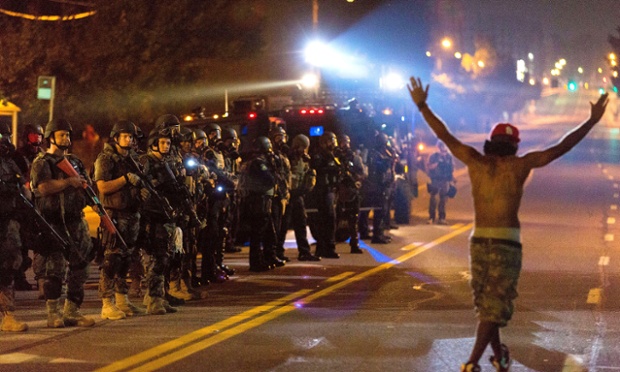
| [Militarized Police and Protester in Ferguson, Missouri Last Week] |
Last Sunday night, as protests over the police
shooting of unarmed black teenager Michael Brown continued into another night
in Ferguson, Missouri (US), I sat to watch Fruitvale Station (2013) a dramatized depiction
of the life/death of another unarmed black male fatally shot by police in
an American city (San Francisco).
Fruitvale Station is the intimately told story of 22 year-old Oscar Grant's final day of life, before his killing by Bay
Area Transport Police on a New Year’s morning metro platform. The film has
a realist, almost experiential quality to it offering a close-grained view into
Oscar’s partially-fictionalized interior word. Whilst the film's director undoubtedly
endeavoured toward verisimilitude and achieves an honest presentation of
the contested terminal encounter, the story is not so much about the particular
circumstances of the killing as it is about Oscar's familial life, his
transitioning masculine self and what the devastation of his murder means
for his girlfriend, their young daughter and his grieving mother (an all
too familiar image of a black mother grieving a dead son; see for example
Michael Brown's mother).
And equally, the substance of the film is ,indeed, what it reveals of the
violence that America visits upon its black citizenry – in this case young
black males.
 |
| [Oscar and his daughter 'T' in Ryan Coogler's Film Fruitvale Station (2013) |
Oscar dies from multiple gunshot wounds at the end of the film, a fate shared with a growing list of black men killed at the hands of police in America – of which Michael Brown is one of the most recent (http://www.alternet.org/civil-liberties/how-often-are-unarmed-black-men-shot-down-police?paging=off¤t_page=1#bookmark ). Fruitvale Station provides provocative viewing, helping us to think through recent events in Missouri and the realities of black male being in America, whilst staving off the lure or reductive tropes. As one reviewer wrote of film's the director,
His main intention — and his great achievement... is to make Oscar a fully human presence, to pay him the respect of acknowledging his complexities and contradictions. The radicalism of “Fruitvale Station” lies precisely here, in its refusal to turn a man into a symbol. Nearly every black man... tends to be flattened out by popular culture and the psychopathology of everyday American life, rendered as an innocent victim, a noble warrior or a menace to society. There is a dehumanizing violence in this habit, a willed, toxic blindness that “Fruitvale Station” at once exposes and resist.
A mother’s
prayer and the silent scene of Oscar playing with his young daughter as he teeters on the brink of death emphatically
underscore the contingency of black American life and uncertain futures.
This film is well worth watching, more today than ever. It is currently
screening in cinemas in the UK and available for sale online.
Some good reviews:
Cited:
David Kyuman Kim.
"Democracy, the Catastrophic, and Courage: A Conversation with Cornel West
and David Kyuman Kim." Theory & Event 12.4 (2009). Project MUSE. Web.
18 Aug. 2014. <http://muse.jhu.edu/>.]
A very brief contextual intro to recent frictions in Ferguson, Missouri:

